IT Jobs 2026 if you’ve spent any time browsing job listings recently, you’ll notice something pretty obvious — technology roles are everywhere. Not just in software houses, but in banks, hospitals, government departments, and even small retail businesses that never used to hire tech staff before. IT Jobs 2026 are being posted at a pace that’s honestly hard to keep up with, and for anyone with even basic technical skills, this is turning out to be one of the best times in recent memory to start or switch careers.
What’s interesting this year is how broad the demand actually is. It’s not just about software developers anymore — network administrators, cybersecurity analysts, database managers, IT support officers, and cloud specialists are all being hired at similar volumes. Both public sector organizations and private companies are competing for the same talent, which genuinely works in the candidate’s favor, whether you’re a fresh graduate stepping into your first job or someone with a few years of hands-on experience.
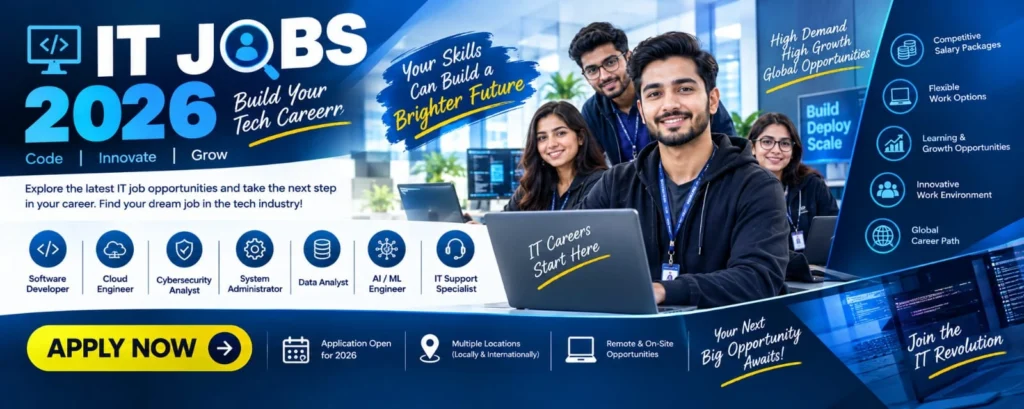
This guide covers everything you need to know about IT Jobs 2026 — eligibility requirements, expected salary ranges, the documents you’ll need ready, and a clear breakdown of how to apply without running into avoidable mistakes. Let’s get into the details.
Job Overview For IT Jobs 2026
| Detail | Information |
|---|---|
| Job Title | IT Officer / Specialist / Technician |
| Sector | Government & NGO/Private |
| Total Positions | Multiple Vacancies |
| Application Mode | Online / Walk-in (varies by organization) |
| Job Location | Multiple Cities |
| Last Date to Apply | October 20, 2026 |
| Employment Type | Full-Time / Contract-Based |
| Experience Required | Fresh to Experienced |
Jobs Vacancies List For IT Jobs 2026
1. Government Sector
Government departments have significantly expanded their IT divisions this year, largely due to the push toward e-governance and digital record-keeping. These roles tend to attract a lot of applicants because of the job security, structured pay scales, and pension benefits that come with them. Common openings include IT Officer, Network Administrator, Database Manager, and System Support Technician, usually spread across ministries, public universities, and municipal offices.
2. NGO/Private Sector
The private and NGO sector is where the bulk of the current hiring is actually happening. Tech companies, banks, e-commerce platforms, and non-profits are all actively recruiting, and many of them offer remote or hybrid arrangements that government roles typically don’t. Positions here range from Software Developer and Cybersecurity Analyst to Cloud Engineer, IT Support Specialist, and Data Analyst, with salaries often more flexible and performance-driven than public sector pay scales.
Eligibility Criteria For IT Jobs 2026
Before submitting any application for IT Jobs 2026, it’s worth going through the basic eligibility checklist so you don’t waste time on a role you don’t actually qualify for.
1. Age Requirements
- Minimum age: 18 years
- Maximum age: 35 years (relaxation may apply for government roles as per policy)
2. Educational Requirements
- Bachelor’s degree in Computer Science, Information Technology, or a related field
- Relevant technical certifications (such as CCNA, AWS, or CompTIA) are a strong plus
- Fresh graduates are encouraged to apply for entry-level and trainee positions
3. Physical/Health Requirements
- Candidate must be medically fit to perform regular office and desk-based duties
- No specific physical fitness test required for most technical roles
4. Gender
- Open to all genders — male, female, and transgender candidates are equally encouraged to apply
5. Additional Preferences
- Prior internship or freelance experience in software development, networking, or IT support
- Familiarity with tools and platforms relevant to the specific role (cloud services, programming languages, ticketing systems)
- Strong problem-solving and communication skills
Salary and Benefits For IT Jobs 2026
Pay scales for IT Jobs 2026 have improved noticeably compared to previous years, largely driven by increased demand and skill shortages in certain technical areas.
1. Salary Range
- Entry-level: Competitive monthly salary based on organization, role, and city
- Mid-level: Higher pay with performance-based increments and skill premiums
- Senior roles: Market-competitive packages, often including project-based bonuses
2. Benefits
- Health insurance coverage
- Paid annual and sick leave
- Performance bonuses and technical incentives
- Remote or hybrid work flexibility (private sector)
- Certification and training allowances
- Provident fund/pension (government roles)
Required Documents For IT Jobs 2026
Sorting your paperwork early will save you a lot of stress when the deadline gets close. Here’s what you’ll typically need when applying for IT Jobs 2026:
1. Academic Documents:
- Bachelor’s degree/transcript
- Relevant technical certifications or diplomas
- Latest academic transcript or mark sheet
2. Identity Documents:
- National ID card or CNIC
- Passport-size photographs (recent)
3. Residency Documents:
- Proof of current address (utility bill or rental agreement)
- Domicile certificate (for government roles, where applicable)
4. Professional Documents:
- Updated resume/CV
- Cover letter tailored to the specific role
- Experience letters (if applicable)
- Portfolio, GitHub profile, or project samples (for development and technical roles)
5. Other Documents:
- Character certificate (if required by employer)
- References or recommendation letters
How To Apply For Jobs?
- Visit the official website or careers page of the hiring organization
- Read the complete job advertisement carefully before applying
- Prepare all required documents in scanned/digital format
- Fill out the online application form accurately
- Attach your updated resume and cover letter
- Double-check all technical qualifications and certifications listed
- Submit the application before the given deadline
- Keep a copy of your submission confirmation for future reference
Test Preparation Guide For IT Jobs 2026
Many government and larger private organizations conduct a technical assessment or coding test before moving candidates to the interview stage.
Recommended Preparation Strategy
- Review core IT concepts relevant to the role: networking, databases, programming fundamentals, or cybersecurity basics
- Practice coding problems or scenario-based technical questions
- Brush up on the specific tools and platforms mentioned in the job description
- Take timed mock tests to build speed and confidence
- Revise general knowledge or aptitude sections if included (common in government tests)
Online Resources
- freeCodeCamp and Codecademy for coding practice
- AWS and Microsoft Learn for cloud certifications
- Cisco Networking Academy for networking fundamentals
- YouTube tutorials from recognized tech trainers
- Industry blogs like TechCrunch, Stack Overflow Blog, and GeeksforGeeks
Expert Tips: How to Increase Your Selection Chances
1. Documentation Excellence Keep every document clear, updated, and correctly formatted. Missing or outdated paperwork is one of the easiest ways to get filtered out before anyone even reviews your technical skills.
2. Understand the Role Read the job description more than once. Applying for IT Jobs 2026 without understanding whether it’s a development role, a support role, or a networking role often leads to mismatched expectations during the interview.
3. Highlight Relevant Experience Even small projects count. If you’ve built a personal app, contributed to open-source, or managed a small network setup, mention it — recruiters appreciate practical, hands-on examples over generic descriptions.
4. Prepare for Interviews Practice explaining past projects, the tools you’ve used, and how you approach problem-solving. Technical confidence usually comes from preparation, not memorization.
5. Apply Early Don’t wait until the last day. Early applications tend to get reviewed more carefully, simply because there’s less backlog on the recruiter’s end.
6. Quality Matters A focused, well-organized resume beats a long, generic one every time. Highlight the skills and tools most relevant to the specific role you’re applying for.
Why This Career Path Is Worth Considering For IT Jobs 2026
If you’re still weighing your options, it helps to look at the bigger picture. Almost every industry today depends on technology to function, which means IT professionals are no longer confined to tech companies alone — they’re needed in banking, healthcare, logistics, education, and government alike. This widespread demand means the skills you build in one sector often transfer smoothly to another, giving you far more flexibility than most traditional career paths offer. IT also rewards continuous learning over static credentials, so people who stay curious and keep upgrading their skills tend to move up faster. Whether you’re aiming for the stability of government roles or the faster growth typically found in the private sector, IT Jobs 2026 offer a genuinely strong mix of security, flexibility, and long-term career potential.
Also Explore: Digital Marketing Jobs 2026 – Apply Now
Frequently Asked Questions (FAQs)
I’m a fresher with no professional experience — can I still apply for these roles?
Yes, definitely. A good number of IT Jobs 2026 are specifically designed for entry-level and trainee candidates. What matters most at this stage is a solid foundation in your field and any personal or academic projects you can showcase during the interview.
Do I need multiple certifications before applying?
Not necessarily. One relevant certification alongside a related degree is usually enough to get considered for entry-level positions. You can always add more certifications later as you specialize in a particular area like cloud computing or cybersecurity.
How long does the hiring process usually take?
It varies by organization, but on average, expect anywhere from three to six weeks between application submission and final selection, especially if a technical test or multiple interview rounds are involved.
Should I focus on government jobs or private sector jobs first?
It really depends on what you value more. If long-term stability and benefits matter most, government roles are worth prioritizing. If you’re looking for faster growth, higher pay potential, and more varied projects, the private sector often suits better. Many candidates end up applying to both at the same time.
What if I don’t have experience with the exact tools mentioned in the job posting?
That’s fairly common and usually not a dealbreaker for entry-level roles. A strong grasp of the fundamentals combined with a willingness to learn new tools quickly is often enough to get shortlisted.
Can I apply from a different city than where the job is located?
In most cases, yes. Just check whether the specific listing requires local residency or offers relocation assistance, since this can vary between government and private sector postings.
- Session Court Peshawar Jobs 2026 – Apply Now for a Stable Career in the Judiciary
- Carrefour Jobs 2026 – Apply Online and Build a Retail Career That Actually Grows
- Sindh Rangers Jobs 2026 – Apply Online for a Career in the Paramilitary Force
- Islamabad High Court Jobs 2026 – Apply Now To Get A Job In IHC
- Sindh Irrigation Department Jobs 2026 – Apply Online – Secure Your Future